Defect Guide
Build one resource chain, then convert it before the fight gets ahead of you.
Take immediate damage and a dependable defense card before adding Orb slots or expensive Powers. Mixed Orbs plus Focus is the safest default. Status/Fuel and Claw become real plans only after the deck owns at least two links in their resource chain.
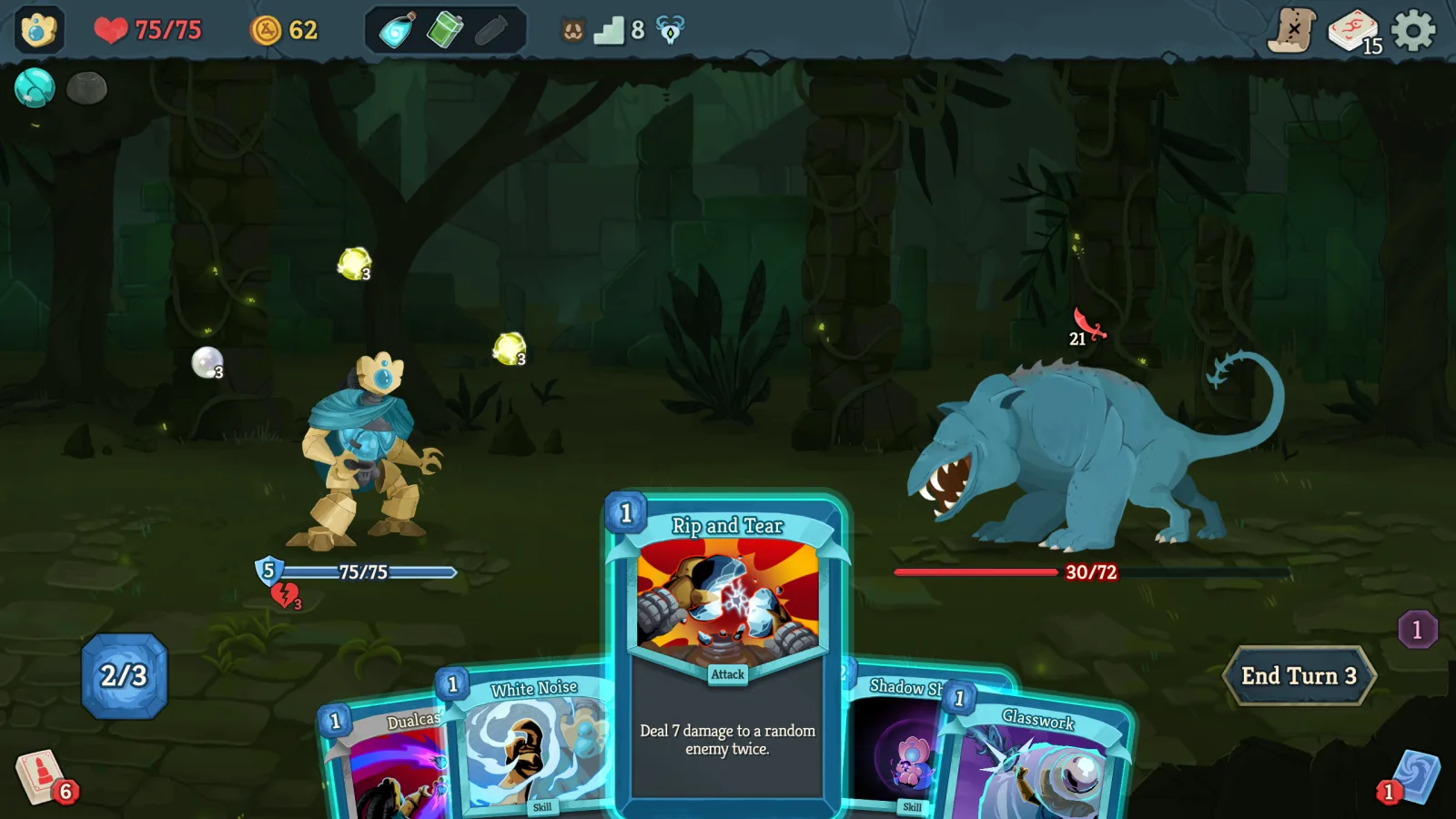
Start with the engine
How Defect actually wins
Defect starts with three Orb slots. Lightning, Frost, Dark and Glass trigger passively at the end of the turn; Plasma pays at the start. Channeling into a full row Evokes the front Orb, so slot count, channel speed and Orb order are one system—not three independent upgrades.
Slay the Spire 2 asks Defect to cash resources in more actively. Glass starts strong and fades, Dark grows while it waits, temporary Focus wants a dense activation turn, and Status cards can become Fuel. A deck that understands when to hold and when to convert will outperform a pile that merely owns many engines.
Floor-one priorities
Act 1: draft answers, not a fantasy deck
- 01 Take damage that works now
Cold Snap, Ball Lightning, Barrage and Sweeping Beam improve the next fights without waiting for Capacitor or a slow Power.
- 02 Stop the five-HP leaks
Coolheaded, Charge Battery, Cold Snap and Glacier prevent the repeated chip damage that otherwise forces every rest site into healing.
- 03 Fill the starting slots first
Three working Orbs make Barrage, Compile Driver and temporary Focus useful. Extra slots before enough Channel can delay the Evokes you needed.
- 04 Demand two links before committing
One Claw is not a loop, and one Trash to Treasure is not a Status deck. Look for a generator plus a consumer, or a consumer plus reliable recursion.
- 05 Upgrade tempo and circulation
Energy changes on Dualcast, Zap and Turbo often matter more than a few damage points. After that, improve draw or remove Exhaust from a card the engine needs repeatedly.
Three packages to recognize
Defect builds that have a real game plan
Treat these as packages, not shopping lists. Move in when you already own the signal cards; keep taking standalone answers when the package has not shown up.
Mixed Orbs and Focus
Use Frost to survive startup, Lightning and Glass for normal fights, and Dark or repeated Evokes for long single targets.
- Core cards
- Cold Snap · Coolheaded · Glacier · Defragment · Hotfix · Synchronize
- Support
- Glasswork · Compile Driver · Hologram · Shatter · Barrage
- Relics
- Data Disk · Gold-Plated Cables · Emotion Chip · Metronome
How a turn plays: Fill the row, place the Orb you want to keep away from the Evoke edge, then use temporary Focus on a turn that triggers several passives or Evokes. Hold Dark; cycle Glass early.
What breaks it: Adding slots faster than the deck can Channel. Empty or slow-moving slots dilute temporary Focus and delay the forced Evokes that provide immediate defense or damage.
Status to Fuel
Create Status cards on purpose, collect their trigger value, then convert the hand pollution into Fuel and another play sequence.
- Core cards
- Compact · Trash to Treasure · Boost Away · Overclock · TURBO · Fight Through
- Support
- Iteration · Smokestack · Rocket Punch · Flak Cannon · Gunk Up
- Relics
- Blessed Antler · Tea of Discourtesy · Letter Opener · Tuning Fork
How a turn plays: Create Status, take any creation or draw triggers, then decide whether the batch belongs to Compact or Flak Cannon. Fuel extends the turn and can trigger zero-cost Skill or Exhaust rewards.
What breaks it: Counting the same Status twice. If Flak Cannon consumes the batch, Compact has no Fuel; if the deck lacks Iteration in Beta, the cycle can also run out of cards.
Claw zero-cost recursion
Replay growing zero-cost attacks instead of waiting to draw each copy once per shuffle.
- Core cards
- Claw · Feral · All for One · Hologram · Reboot
- Support
- FTL · Beam Cell · Go for the Eyes · Scrape · Turbo
- Relics
- Power Cell · Music Box · History Course · Shuriken
How a turn plays: With Feral, make Claw the first zero-cost Attack of the turn so it returns to hand. Use Hologram and All for One to repeat the same strong cards, not merely to increase cards played.
What breaks it: Forcing the meme after one Claw. Without recurrence, the card grows too slowly and Scrape can discard the defense or setup that the run still needs.
Items worth changing your plan for
Recommended relics and why they fit
Data Disk
One Focus improves Lightning, Frost, Dark growth and Glass from the opening turn.
Plasma does not scale with Focus.Gold-Plated Cables
The front Orb gains another passive trigger, rewarding deliberate Orb ordering.
The benefit lands on the front slot, which is also closest to being Evoked.Emotion Chip
Taking HP damage can trigger every Orb again and create a large recovery or damage turn.
Do not deliberately take a bigger hit than the extra activations can repay.Power Cell
Starting with two zero-cost cards from the draw pile gives Claw or other cheap engines a faster first cycle.
Its value depends on the actual zero-cost pool in the deck.Runic Capacitor
Fast Channel decks gain more passive value and room to stage Dark or Plasma.
Skip it when extra slots would only delay your next Evoke.Execution wins close fights
How to pilot the deck cleanly
- Check the front Orb before Dualcast. A mature Dark is worth doubling; a newly channeled Dark usually is not.
- Glass loses power as turns pass, while Dark grows. Evoke Glass early and give Dark time when the fight allows it.
- Pair temporary Focus with a full Orb row, extra passives or Shatter. Using it into empty slots wastes the burst window.
- In a Feral deck, play the zero-cost Attack you most want returned before casually playing FTL or another cheap Attack.
- Decide whether Status cards are Compact fuel or Flak Cannon ammunition before spending them. The same batch cannot pay both cards.
- Hologram should retrieve the answer the turn needs—Block, Channel, Evoke or recursion—not automatically the card with the strongest theme label.
Common mistakes
- Copying the first game's permanent Focus-and-Frost autopilot. The sequel leans harder on temporary Focus and active conversion turns.
- Taking Capacitor whenever it appears. Extra slots are a cost when the deck cannot fill them quickly.
- Channeling only Lightning and hoping damage races everything. A reliable Frost or Block layer prevents the run from bleeding out.
- Refusing good cards after seeing one Claw. Claw needs repeated use, not faith.
- Mixing half a Tesla Coil plan, half a Claw plan, one Dark payoff and a few Status cards. Complete one chain before buying another engine.
- Using Main Rocket Punch or Shatter assumptions on Beta. Their cost loop and repeatability changed.
Current experimental branch
What Beta v0.111.0 changes for Defect
Beta v0.111.0 keeps the stronger Orb burst plan while reducing Synchronize's Focus and reworking Hyperbeam's temporary Focus loss. Defect still benefits from front-loaded attacks that help reach the engine stage with more health.
The temporary-decay Power produces a stronger immediate Orb turn.
Mixed-Orb decks retain a temporary conversion tool, but the latest beta gives it a smaller Focus ceiling.
Status decks need more generators before the attack becomes free.
Beta needs Iteration or another draw engine instead of assuming Fuel replaces itself.
Treat it as a planned finisher or emergency conversion, not a card the deck will loop repeatedly.
The latest beta keeps the large area hit but limits the Focus loss to the current turn.